Acquisition Currency: What the Largest Defence IPO Was Actually For
CSG's Amsterdam listing in January was the biggest defence flotation on record. Most of the money raised did not go to the company.
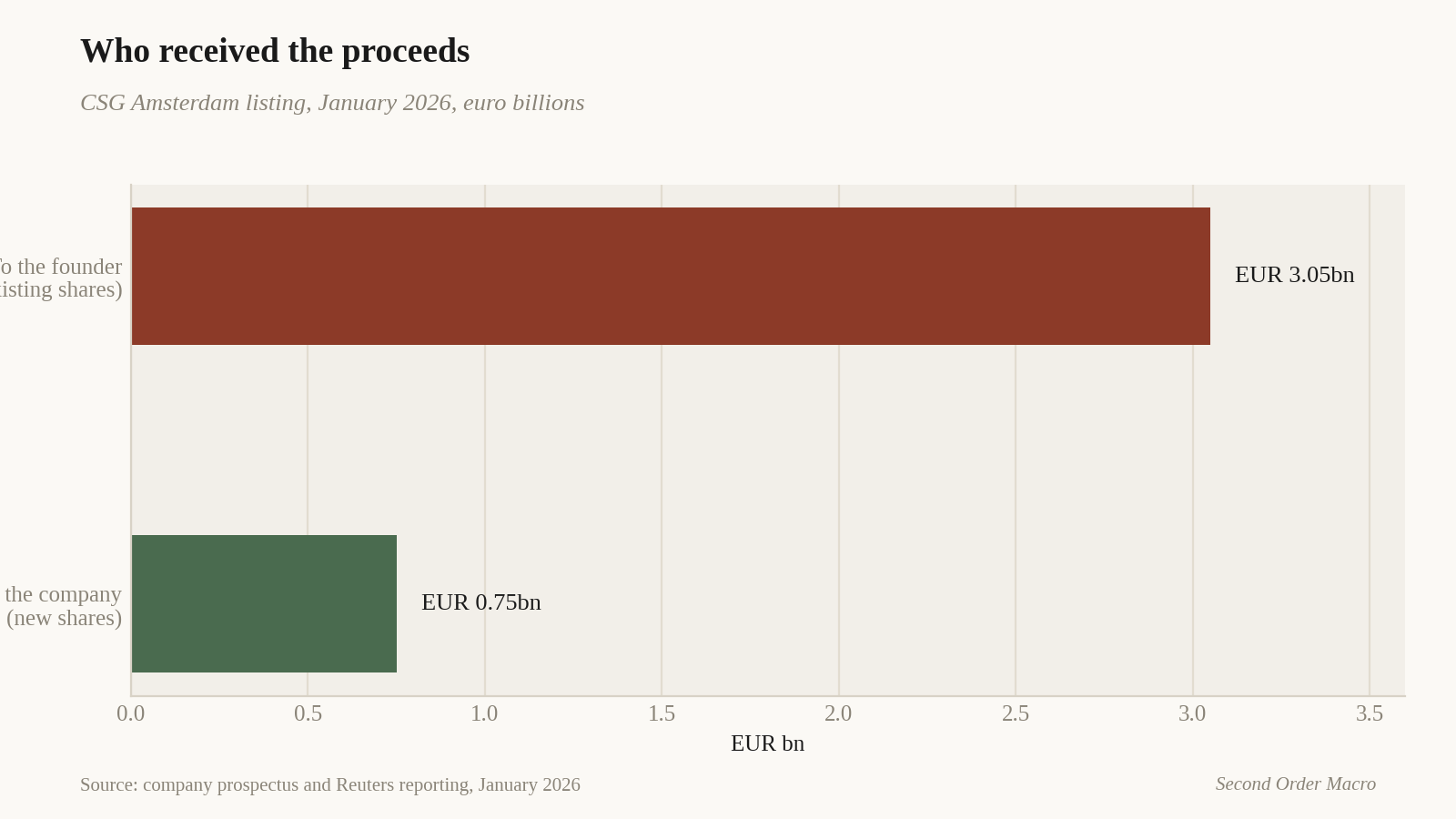
In January, Czechoslovak Group listed on Euronext Amsterdam at €25 per share, raising €3.8 billion against an initial market capitalisation of €25 billion. It was the largest defence flotation ever recorded, by money raised and by valuation, and the largest Amsterdam listing since 2006. The shares closed the first day up more than 31%, lifting the implied capitalisation above €33 billion, which made a Czech ammunition manufacturer more valuable than the country’s largest utility.
The story was reported as evidence that Europe’s rearmament is now being financed in public equity markets. That reading is not wrong, but it obscures something more interesting about what the transaction actually did.
If a listing raises €3.8 billion and the company receives less than a quarter of it, what has been financed?
The offering combined 30 million new shares with up to 122 million existing ones. New shares bring cash into the business. Existing shares transfer ownership from a seller to a buyer and bring the company nothing at all. Michal Strnad, the founder, netted just under €3 billion from the sale of his own holding while retaining control. The company itself received the proceeds of the new share issuance, earmarked for general corporate purposes.
This distinction between primary and secondary issuance is elementary and almost always lost in the reporting of large listings, because the headline figure combines the two. It matters here because the popular narrative holds that European capital markets are funding an expansion of production capacity. Roughly a fifth of this particular transaction did that. The rest converted a private fortune into a liquid one.
Strnad has been unusually candid about the strategic purpose, saying before the listing that he wanted the option of using shares as currency for acquisitions. The company had already bought an American small-calibre manufacturer for $2.2 billion in 2024. A listed equity provides something a private holding company cannot, which is a tradeable instrument to offer vendors in place of cash.
That reframes the transaction considerably. Read as a fundraising, the IPO is a modest capital injection. Read as the creation of an acquisition currency, it is the opening move in the consolidation of a European defence industry.
There is a wrinkle here that corporate finance teaches early. Myers and Majluf showed that managers with better information than the market will tend to issue equity when they believe their shares are generously valued, which is why announcements of equity issuance are so often received badly. A founder selling €3 billion of personal stock into a sector at record highs, while explicitly planning to spend the remaining paper on acquisitions, is behaving exactly as that model predicts. Investors bid the shares up 31% regardless, which tells you how strongly the rearmament narrative currently overrides the usual scepticism.
None of this makes the equity expensive. The backlog is real and European defence budgets are rising in a way that appears structural rather than cyclical. The question is whether the capital now flowing into these companies is reaching the factories, or whether it is mostly changing hands between investors while the sector consolidates.