Breadth without Conviction
The equal-weighted S&P is beating the cap-weighted index and every sector saw upward revisions. But is capital moving into other sectors because investors like them, or because they ran out of room in the one they prefer?
The most encouraging development in American equities this summer has been the return of breadth. After a decade in which index returns depended on a small group of technology names, other sectors have begun to contribute. Goldman Sachs set out the constructive version of this argument in late August, when Shawn Tuteja of the firm’s ETF and custom basket volatility desk described a market broadening beyond artificial intelligence, supported by a rotation into sectors that had been written off earlier in the year. The equal-weighted S&P 500 has outperformed its capitalisation-weighted equivalent by close to 300 basis points this year, which is the kind of statistic that usually accompanies a healthier market.
The fundamental case is difficult to argue with. FactSet reported that with 88% of the index having filed second-quarter results, 86% delivered a positive earnings surprise, against a five-year average of 78% and a ten-year average of 76%. In aggregate, companies exceeded estimates by 29.2%, where the five-year average is 7.0%. Every sector saw earnings revised higher relative to where they stood at the end of June. This is not a narrow rally supported by a handful of firms.
Yet I would be cautious about reading the broadening as evidence of confidence.
Is capital moving into other sectors because investors like them, or because they have run out of room in the sector they prefer?
The distinction matters more than it might appear. A market that broadens because investors have identified undervalued fundamentals elsewhere is behaving as textbooks describe. A market that broadens because a crowded position has become too volatile to hold at size is doing something rather different, and the two are indistinguishable if you observe only sector returns.
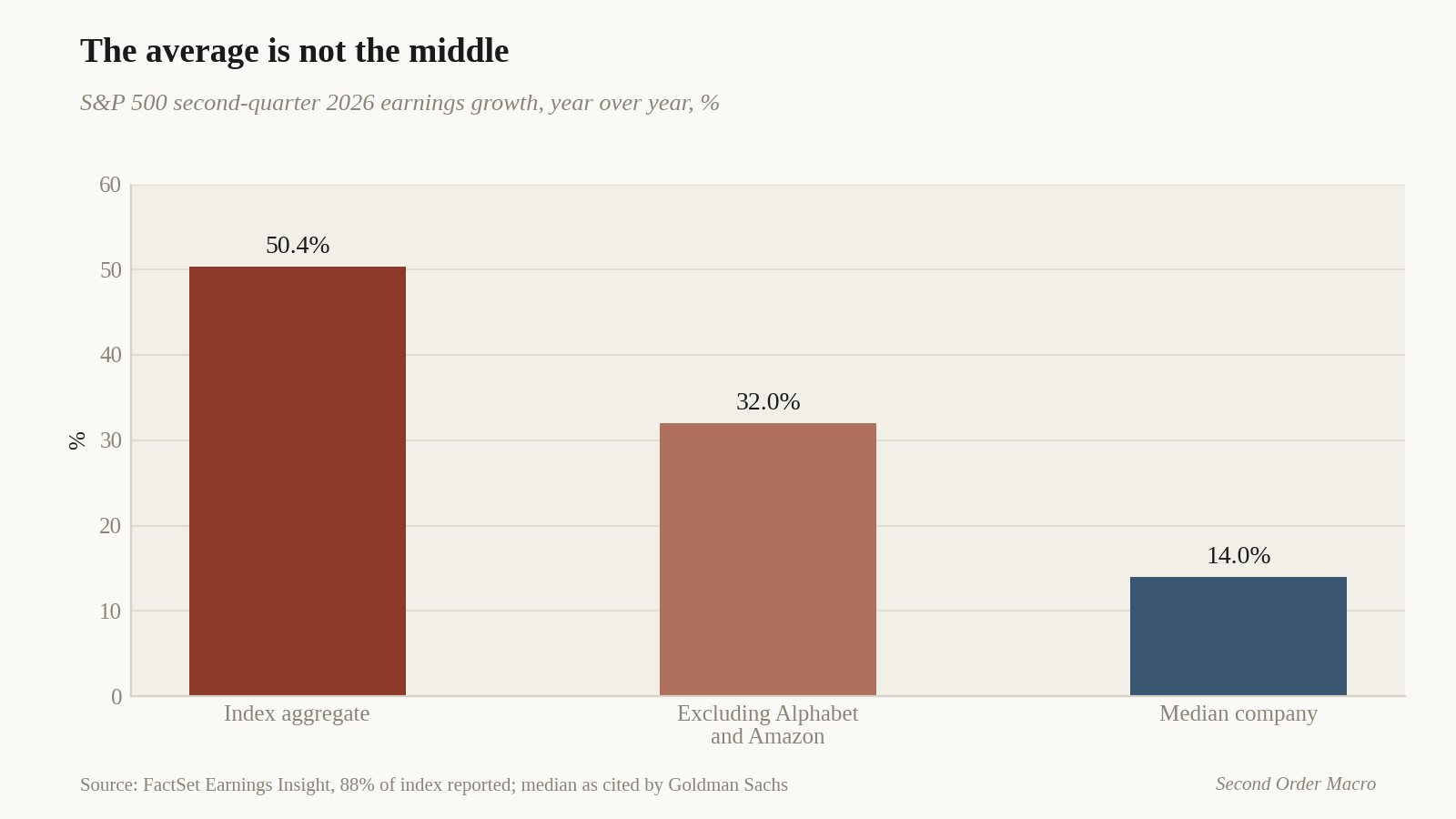
Consider first how uneven the earnings picture remains beneath the headline. FactSet’s blended growth rate for the quarter reached 50.4%, an extraordinary figure, while Tuteja put the growth rate of the median company at 14%. Both numbers describe the same quarter. The gap between them exists because the aggregate is weighted by size, so a small number of very large companies determine it, and one unusually large surprise from Alphabet distorted the average further. A 14% median is genuinely good. It is not the same phenomenon as a 50% aggregate, and confusing the two is how a concentration story gets mistaken for a broadening one.
The positioning data points in the same direction. Goldman reported the heaviest net buying on its prime brokerage book since the pandemic over recent weeks, while gross risk declined. Those two facts sit oddly together until you consider what produces them. Gross exposure falls when investors reduce the overall size of their positions on both sides of the book. Net buying rises when they lean long. An investor doing both at once is not adding conviction but redistributing a smaller quantity of risk across a wider set of names.
There is a mechanical reason why this would happen. When a position begins moving at double or triple its normal daily range, the risk it contributes rises even if its size does not. Any investor operating under a volatility budget, which describes most institutional capital, must then reduce the position to remain within the constraint. The selling reflects no change of view. It is arithmetic.
That is what occurred across the AI complex in July, when every component of the theme fell together on a volatility-adjusted basis. Whatever an investor believed about optical networking relative to memory, the correlation between them eliminated the diversification benefit of holding both, and the sensible response was to hold less of each. The capital released had to go somewhere, and much of it went to sectors dismissed earlier in the year on the assumption that artificial intelligence would disrupt them.
The most revealing observation of the earnings season supports this reading. Tuteja noted that technology companies beating their estimates underperformed the index by roughly 130 basis points on the following day. A market genuinely enthusiastic about these businesses does not sell good news. What it expresses is uncertainty over when earnings peak rather than doubt about whether earnings are strong, and that uncertainty is itself a source of volatility, which feeds back into the reduction in position size.
Implied correlation across the index has meanwhile fallen close to the lowest levels on record. In plain terms, the options market is pricing individual stocks to move independently rather than together. This is the statistical signature of the process described above. Money spread thinly across many sectors produces a market in which nothing moves in unison, because no single view is being expressed with any force.
None of this makes the earnings picture false, and the sectors receiving inflows may deserve them on their own merits. Healthcare has been cheap and underowned for some time. Software was grouped into a disruption narrative that its results have not borne out.
The question is what happens to the broadening if the constraint that produced it is removed. Should volatility in the AI complex subside, and there are reasons to expect it might as those companies sign longer-term agreements and return capital to shareholders, the volatility budget that forced capital outward would loosen. The same arithmetic that pushed money into healthcare would permit it to return.
Breadth driven by conviction persists when conditions improve. Breadth driven by a risk constraint reverses when the constraint lifts. The coming months should distinguish between them, and the cleanest test will be whether the equal-weighted index holds its advantage during the next period of calm rather than during the next period of stress.