One Day of Relief: Why the Treasury Could Not Hold the Long End
Washington doubled its long-end buybacks last week and thirty-year yields fell sharply. They had recovered the entire move within a day.
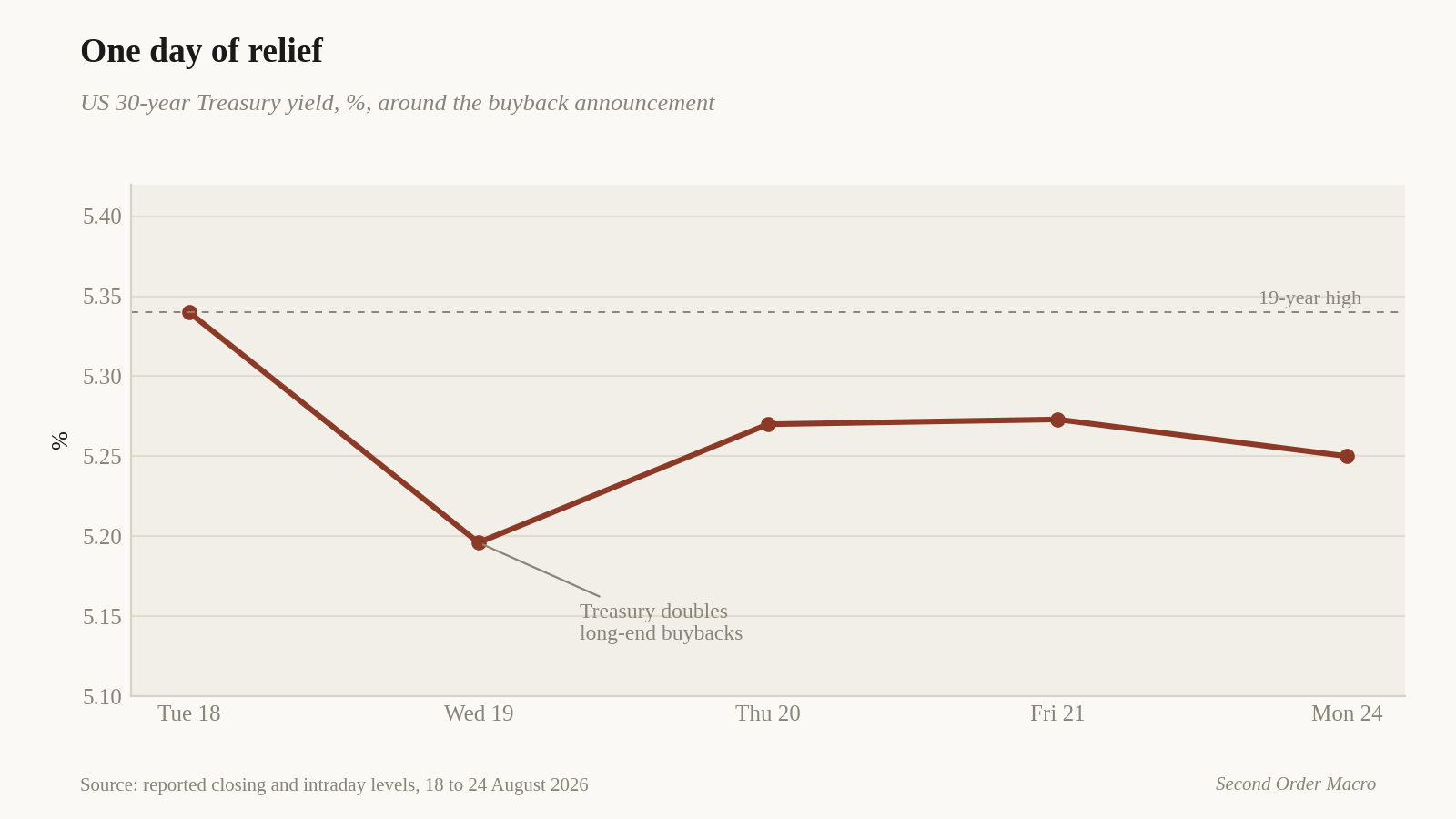
Last Tuesday the thirty-year Treasury yield reached its highest level since 2007. On Wednesday the Treasury Department announced that it would at least double the size of its liquidity support buyback operations in the longer-dated sectors, effective from September. The announcement was a surprise, arriving only two weeks after the quarterly schedule had been published, and long yields fell immediately.
By Thursday the thirty-year had recovered most of the move. By Friday it stood higher than it had been a week earlier. The intervention lasted approximately one trading day.
Why did an announcement of additional demand fail to move a market that had just been complaining about too much supply?
The answer requires separating two things that are easily confused. A buyback of this kind is a liquidity support measure. The Treasury repurchases older, less actively traded securities from dealers, which improves the functioning of the secondary market and gives holders of off-the-run paper somewhere to sell. It is a useful mechanism, and the Treasury was explicit that liquidity support was its purpose. What it is not is a reduction in the quantity of duration the market must absorb, because the repurchases are funded by issuing elsewhere. The operation alters the composition of outstanding debt rather than its total.
The long end has been in what strategists describe as a buyers’ strike since late June, and the reasons are structural rather than technical. American federal borrowing is rising against a deficit that looks likely to exceed last year’s. Corporate issuance to fund artificial intelligence infrastructure has reached an extraordinary scale and competes for the same investors. European governments are borrowing to rearm, and British gilts already trade above 5%. Almost every large issuer is seeking duration at once.
The picture worsens when you consider who used to buy it. Japanese institutions have historically been among the most reliable purchasers of long-dated foreign debt, for the simple reason that domestic yields offered them nothing. That has changed. The Japanese thirty-year now yields above 4%, and Japanese investors have been selling American paper as capital returns home. A dependable buyer has not merely stepped back but become a seller, and the cause is a rise in domestic yields driven by fiscal expansion in a country whose debt already exceeds twice national output.
The loanable funds model states that the real interest rate clears the market for savings, and that heavy borrowing by one party raises the cost for everyone else. The version taught in lectures concerns government deficits crowding out private investment. What is happening now is more interesting, because a substantial share of the additional borrowing is itself private. Technology firms financing data centres are competing with sovereigns for the same finite pool of long-term savings, at precisely the moment when one of its largest suppliers has begun repatriating capital.
Against that, a modest increase in operation sizes for eight weeks is a small instrument, and the market appears to have reached the same conclusion within a day.
I would not dismiss the announcement entirely. Analysts at ING made the sharper observation that the intervention reveals discomfort at the top, and that its significance lies in the precedent rather than the operation. Treasury has demonstrated that it will act when the long end becomes disorderly, and that it can double the size again. The buyback may therefore function less as a source of demand than as a signal about the level of yields at which Washington begins to intervene, which is useful information even if it changes nothing about the direction of travel.
That raises an uncomfortable question for the coming months. Financial conditions are tightening through the long end for reasons monetary policy did not create and cannot easily address. The Federal Reserve sets an overnight rate, while the pressure is arriving through the term premium, driven by fiscal conditions in several countries simultaneously. If Japanese auctions disappoint over the next fortnight, the transmission back into Treasuries would arrive faster than any buyback could offset.