The Chair Who Won't Guide
Kevin Warsh delivers his first Jackson Hole address on Friday. The question is not whether he sounds hawkish or dovish, but whether a market trained on forward guidance can price September without it.
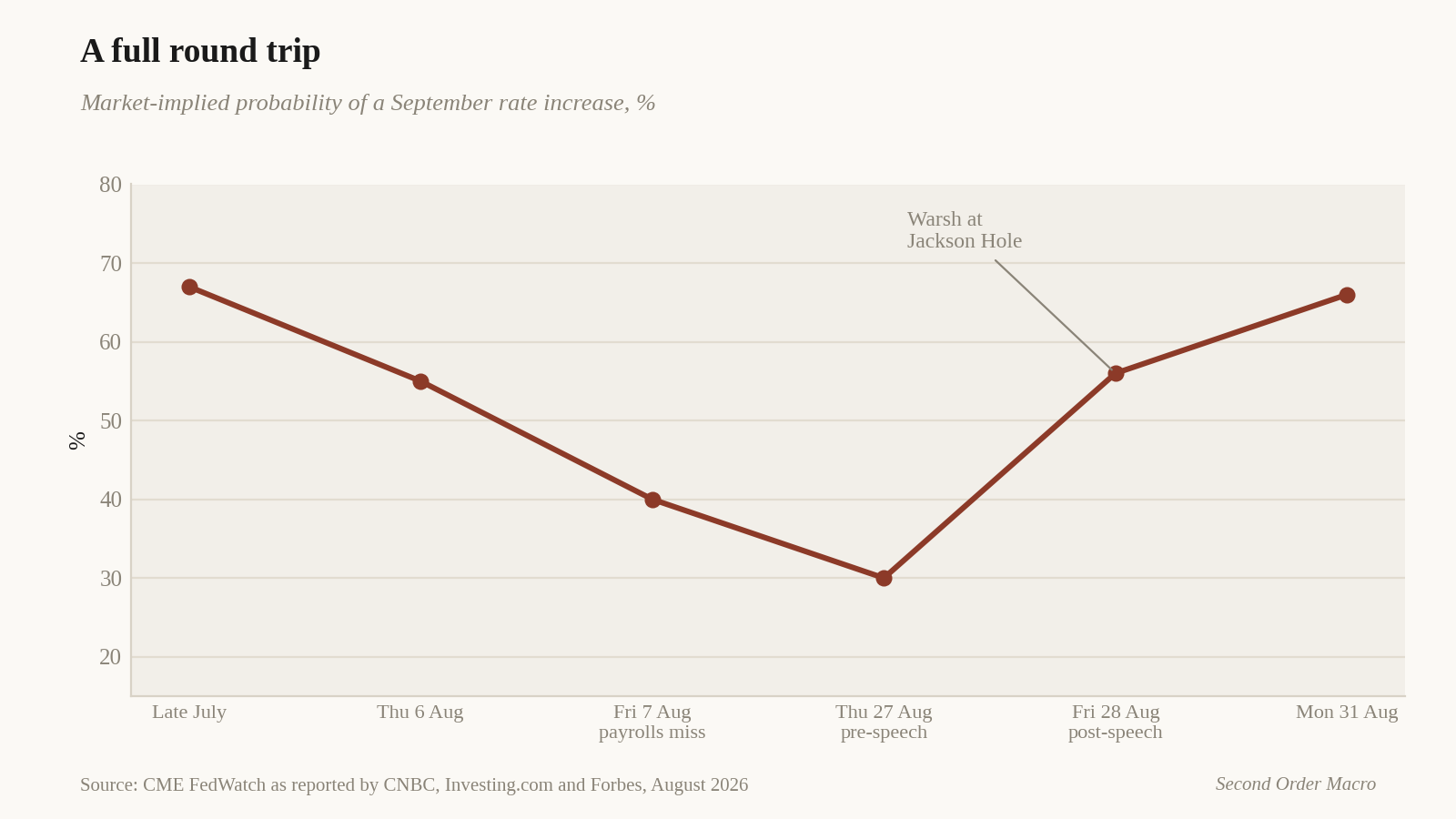
On Friday morning, Kevin Warsh will deliver his first Jackson Hole address as Chair of the Federal Reserve. Almost every preview of the speech asks the same question, which is whether he will sound hawkish or dovish and what that implies for September. I would argue that this is the wrong question, and the reason why reveals something about how monetary policy actually operates.
The federal funds target has stood at 3.50% to 3.75% since January, and this has been a hike-watch year rather than a cut-watch one, which would have seemed an odd thing to say twelve months ago. Inflation is running in the mid-threes, with July CPI at 3.4% and the labour market is deteriorating, with July payrolls falling by 23,000. Furthermore, the mandate has been split down the middle, not signalling comfortability in the central bank.
Markets have responded. Odds of a September hike stood near 58% immediately after the July meeting and have since fallen to roughly a third. That repricing occurred on incoming data alone, because the Fed said nothing to encourage it.
What happens to a market trained on forward guidance when the guidance stops?
To see why this matters, it is worth recalling what forward guidance was for. A central bank sets a single overnight rate at which almost nobody in the real economy borrows. The overnight rate matters principally through its influence on expectations of every future overnight rate, and forward guidance allowed a central bank to move those expectations without moving anything else.
Warsh has withdrawn that instrument. He removed forward-looking language from the FOMC statement, declined to submit a projection to the June dot plot, and told reporters in July that his Jackson Hole remarks would address long-term structural questions rather than near-term guidance. He has stated that the Fed will act independently of market pricing, and describes his public language since taking office in May as deliberately spare.
Two implications follow, neither of which is captured by asking whether Friday sounds hawkish.
The first is that this represents a considered philosophical position. Monetary economics contains a long argument over whether central banks should follow rules or exercise discretion, and one of its more durable results is the time inconsistency problem, which holds that a policymaker free to revise their intentions will eventually be believed by nobody. The conventional solution has been transparency, since an announced path becomes self-enforcing once credibility is staked upon it. Warsh appears to have drawn the opposite conclusion. Credible guidance binds a central bank to a path it may later regret, while guidance that lacks credibility is merely noise. The alternative is to say little, respond to data as it arrives, and allow the market to infer the reaction function from observed behaviour. It is a defensible position, and a considerably harder environment in which to price risk.
The second implication is subtler. The bond market has been tightening financial conditions on the Fed’s behalf. Long yields have risen for reasons largely unconnected to the overnight rate, driven by an unusually heavy global supply of long-dated issuance. Hyperscaler capital expenditure requires funding in the United States, European governments are borrowing to rearm, and Japan is running a substantial fiscal programme. That paper must find buyers, and the price of finding them is a higher yield at the back end.
This leaves a chair who does not guide in an awkward position. Conditions are tightening for reasons the Fed did not cause, and the usual channel for pushing back has been disabled. Warsh cannot lower long rates by promising a friendlier path, having abandoned the practice of promising anything. What he can do is demonstrate a reaction function clear enough that the market prices the path correctly without instruction.
That is the genuine test on Friday. The question is not tone but whether he conveys enough about how he weighs a 3.4% inflation print against a contracting payroll number for the curve to price September unaided.
There is reason to expect he might. This year’s symposium theme concerns financial innovation and its implications for payments, which reads as an invitation to discuss digital payment infrastructure rather than rates. Chairs, however, tend to use the platform for whatever the moment demands rather than for what the programme suggests. Powell’s 2020 framework shift arrived under a review-themed agenda, and his 2022 remarks on the pain of disinflation lasted roughly eight minutes while ignoring most of what surrounded them.
One further matter sits alongside the speech. The July meeting drew three regional presidents dissenting in favour of a hike, which is a high count for a chair two meetings into the role. Given how little this chair says by choice, the Committee’s internal disagreement may prove more informative about the direction of policy than the keynote itself.
In the absence of forward guidance, the loudest signal is rarely the one from the podium.