The Cost of Saying It Depends
The Bank of England spent the spring trying to communicate conditionally about an energy shock. The gilt market heard something simpler.
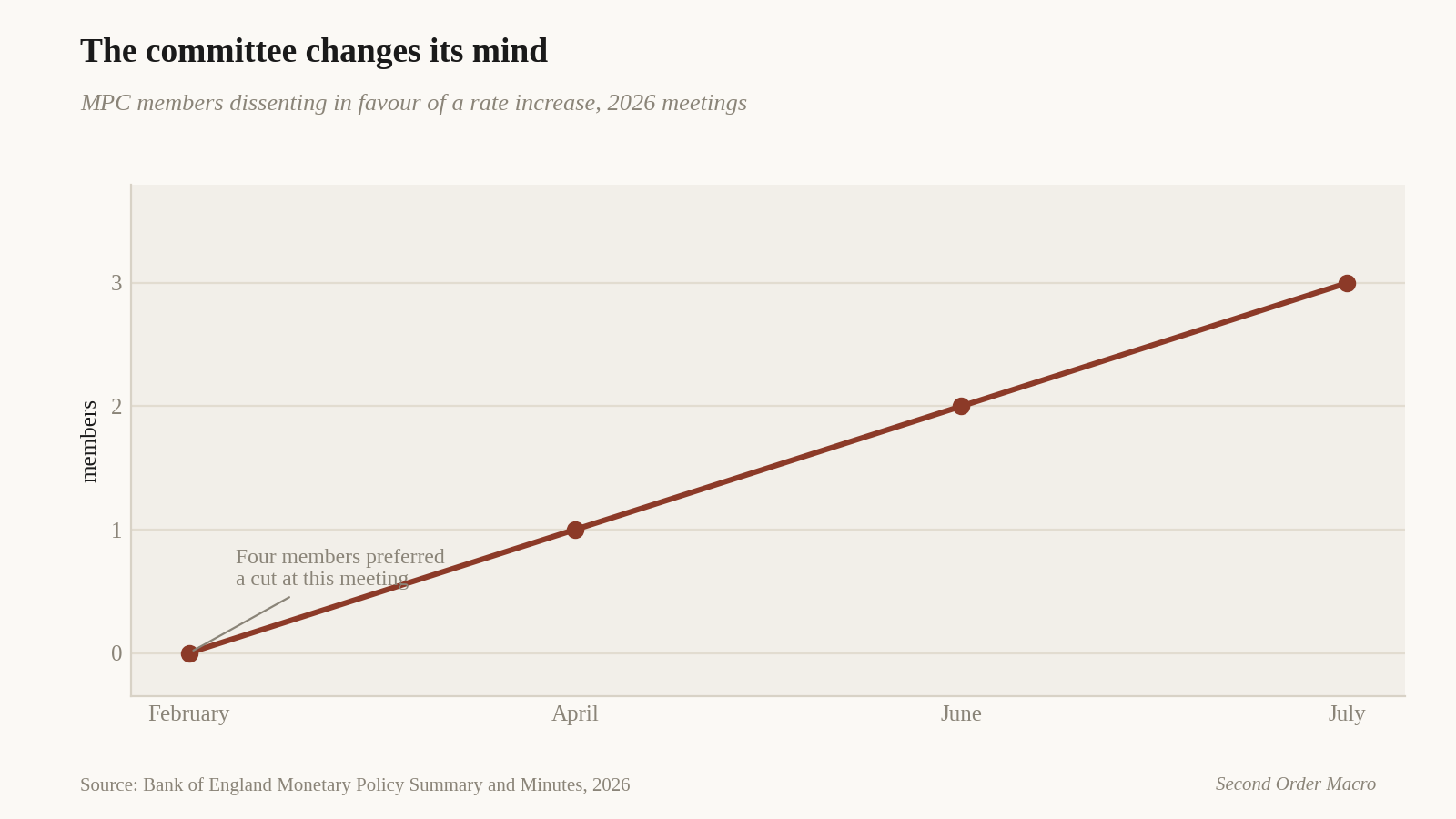
The Bank of England holds Bank Rate at 3.75% on the last day of April, by a majority of eight to one, with the chief economist dissenting in favour of a rise. The decision surprises nobody. What makes the meeting interesting is the six weeks that precede it.
In March the Committee had held while accompanying the decision with a narrative hawkish enough to raise the prospect of an April increase. The gilt market repriced violently, with the ten-year benchmark reaching levels last seen during the global financial crisis. The Governor then spent a fortnight walking the market back, telling investors they were getting ahead of themselves. By the time April arrives, roughly 70% odds of a June hike are priced. The statement lands softer, and yields fall again.
What does a central bank do when the outcome genuinely depends on something it cannot forecast?
The Bank’s answer is unusually sophisticated. Its April Monetary Policy Report abandons the pretence of a single central projection and sets out a range of scenarios for how the Gulf conflict might resolve, with policy explicitly conditional on which materialises. The Committee states plainly that monetary policy cannot influence energy prices. This is intellectually honest, and broadly what the Bernanke review of the Bank’s forecasting recommended.
The difficulty is that conditional guidance asks the market to do something markets are poor at. A yield curve is a single set of prices. It cannot hold several futures at once, so it collapses them into one, and the weight given to each scenario is inferred rather than stated. When the Bank publishes a range of outcomes without indicating which it believes, the market extracts the most hawkish reading and trades it. The correction that follows is not the market misbehaving. It is what happens when prices are asked to express a probability distribution.
What this illustrates is that a central bank signalling tightening one month and counselling patience the next produces something worse than either message, which is uncertainty about the reaction function itself. That is a financial condition in its own right, and not a benign one.